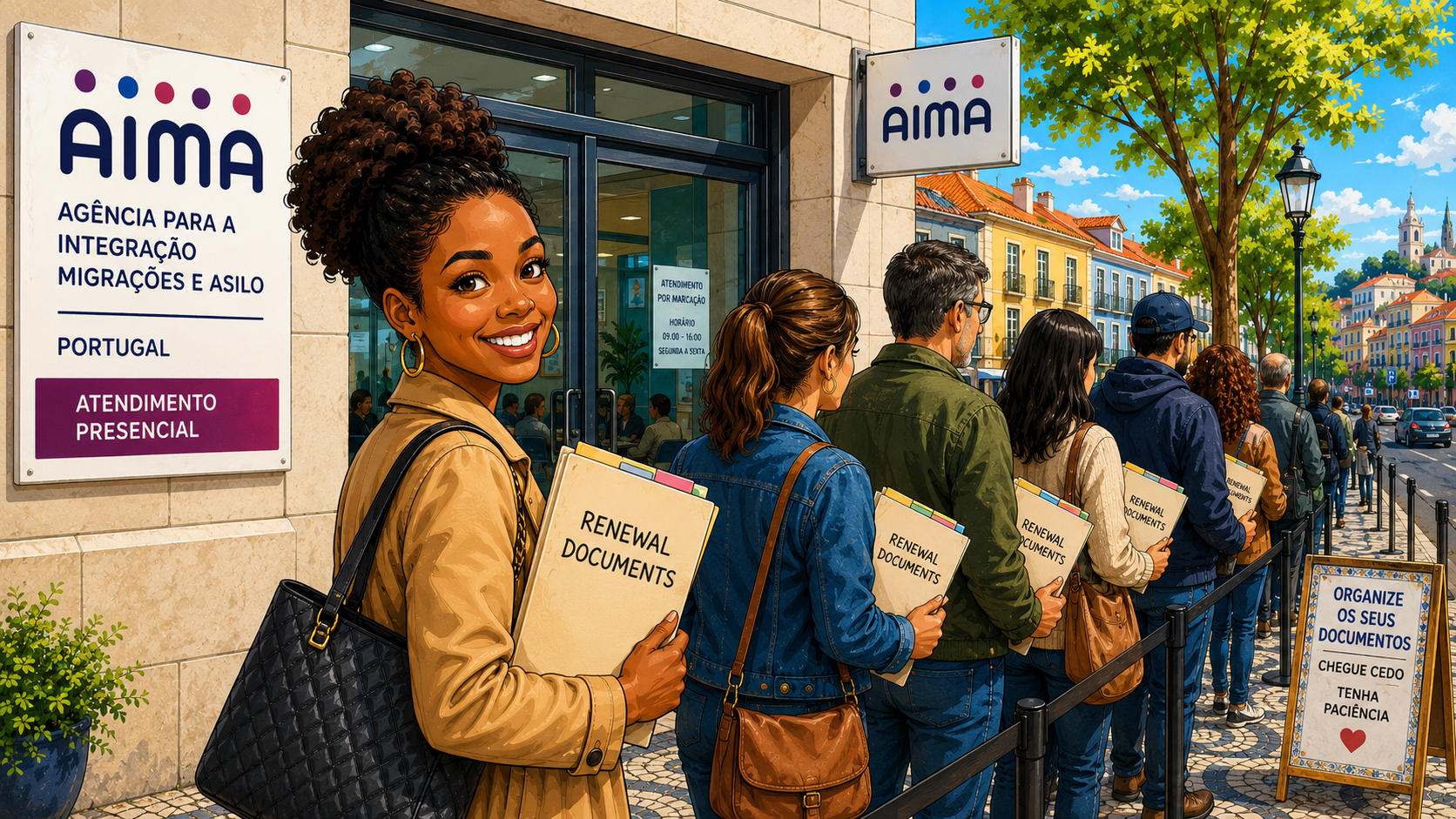
You Can Do Everything Right and Still Get Stuck: What Portuguese Residency Renewal Actually Looks Like
I prepared for my renewal.
I marked the dates. I gathered the documents. I paid the fees on time. I did all the things a competent, organized person does, the same things I would tell a client to do.
I am still stuck.
That is the part I want to talk about, because most of what is written about AIMA residency renewal frames delay as a preparation problem. Start earlier. Be more organized. Read the guidance. All of that advice is worth following. But it is not the whole story, and pretending otherwise leaves people blaming themselves for something that was never in their hands.
I am writing this from inside my own unresolved renewal. Here is what I am learning in real time.
The problem isn’t you
Since AIMA (Agência para a Integração, Migrações e Asilo) took over from SEF, the agency has been working through an enormous backlog of hundreds of thousands of cases, many of them inherited from the transition itself. Wait times, communication gaps, and processing delays have defined the system for the past several years. Renewals are not exempt.
Portugal has made real progress. Digital renewals have improved. The agency has cleared a substantial share of its pending files. But “improved” and “reliable” are not the same thing, and the remaining friction does not distribute itself according to who prepared best. It lands on whomever it lands on.
This is worth naming plainly, because I have watched capable, meticulous people conclude they must have done something wrong when their file went quiet. Usually, they didn’t.
The timeline, spelled out
None of what follows will make you immune. What it will do is give you more room to maneuver when something goes sideways, and that room is worth a great deal.
Start 4 to 6 months before your card expires. Not two months. Not “when I get the email.” AIMA’s own guidance points to this window. Given how unevenly the system processes cases, that buffer is not excessive caution. It is the margin that absorbs a problem you did not cause.
Renewals now largely move through AIMA’s digital portal, which opens applications in phases tied to your card’s expiration date. This is a genuine improvement over the early SEF-to-AIMA chaos, but it also means your timing is not fully in your control. The portal has to be open for your renewal window before you can even begin.
There is a grace period. If your card expires before your renewal is resolved, non-EU nationals get a six-month grace period during which your expired card, plus proof that you submitted your renewal, still counts as evidence of legal residence. This matters enormously, but it only helps if you have that proof in hand, which means submitting before expiration, not after.
What actually goes wrong, and who it happens to
These are the failure points I see most often, and none of them are preparation failures.
Your address, NIF, and Social Security number have to match what AIMA has on file, exactly. A mismatch, even a small one, can stall your submission before it is ever reviewed.
Cards get lost in the mail. AIMA sends physical residence cards through CTT, Portugal’s postal service, and a meaningful number are returned undelivered because of address issues or failed delivery attempts. You can be fully approved and still be stuck waiting for a document that is bouncing around the postal system.
There is now a document for exactly this problem. As of early 2026, AIMA began issuing a formal “proof of approval” for applicants who have been approved but have not yet received their physical card. If you find yourself in that limbo, ask for this document. It gives you something concrete to show while you wait.
Payments can vanish into a system that does not acknowledge them. This is where I am right now. I paid my renewal fees, on time, through the proper channel. The payment did not register on my file. When I followed up, AIMA’s answer was that this is a known technology issue on their end and it needs time to resolve, with no estimate on how long. I have a payment confirmation. Their system does not. There was no step I skipped and no box I left unchecked. The transaction simply did not land on their side, and the consequence is mine to carry until someone there fixes it. If this happens to you, keep every receipt, screenshot, and confirmation email in one place from the moment you pay, not after something goes wrong. The latest advice I have received from AIMA is to pay the fee again and request a refund later. This is after having been sent to at least six different locations, writing numerous emails, sending registered letters, etc. over the course of the past eight months. It’s not the money, it is the principle but I have come to accept this is probably the best action to take at this point along with hiring an immigration attorney.
The legal safety net is changing. For years, Portuguese administrative law included a mechanism called deferimento tácito (tacit approval). If AIMA failed to decide your renewal within 60 days through no fault of your own, your request was treated as automatically approved. This has functioned as a real pressure valve for people stuck in the backlog. As of this year, Parliament has moved to remove it as part of a broader reform to the Foreigners Law. The change cleared its first parliamentary vote in June and went to committee for a final vote, so as of this writing it is not yet fully in force. But the direction is clear: that safety net is going away. If your renewal has been sitting for months, this is the moment to get informed about your options, not next year.
What you can actually control
You cannot control AIMA’s backlog, its payment systems, or the postal service. What you can control is how much margin you build and how well you can prove what you did.
- Mark your renewal window on a calendar the day you get your first card. The buffer is the whole point. It is what turns a system failure into an inconvenience rather than a crisis.
- Keep digital and physical copies of everything you submit, with dated proof of submission. When the system loses track of you, this is what puts you back on the map.
- Save your payment confirmation the moment you pay, before you close the tab. Their system failing to register your payment does not mean your payment did not happen. Make sure you can prove which one is true.
- Don’t assume silence means safety. With the tacit approval mechanism on its way out, a stalled file may need you to act rather than wait.
- If your card doesn’t arrive after approval, ask for the proof of approval document. Don’t just keep checking the mailbox.
- Follow up on a schedule you set. Waiting to be contacted is not a strategy in a system with known communication gaps.
None of this is meant to frighten you out of the life you have built here. It is meant to make sure bureaucracy is something that happens around you, not to you. And it is meant to say clearly that when it happens to you anyway, that is not a verdict on your competence.
My own renewal is not resolved yet. I will write the follow-up when it is, because I think the ending matters as much as the middle. For now, my confirmation is filed, I am following up on my own schedule rather than waiting to be contacted, and I am treating “it’s a known issue” as a starting point rather than a closed door.
Navigating AIMA, renewals, and the fine print of Portuguese bureaucracy is exactly the kind of thing I help clients get ahead of, before it becomes a crisis instead of a calendar reminder. If you are not sure where your own timeline stands, a Clarity Session is the place we sort that out together and figure out what kind of ongoing support actually makes sense for your situation.





I think it’s so important to share these difficulties because it’s the reality that people really need to know. It would be easy to wax poetic and paint the journey as one of calm seas and sun but showing that there is indeed rain sometimes is incredibly honest. Well done.
Thank you. I strive to be transparent with people who are making the monumental decision to move abroad. I want my audience to be informed so they can make choices based on actual experiences rather than the glitter and rainbows sold every day on the internet.