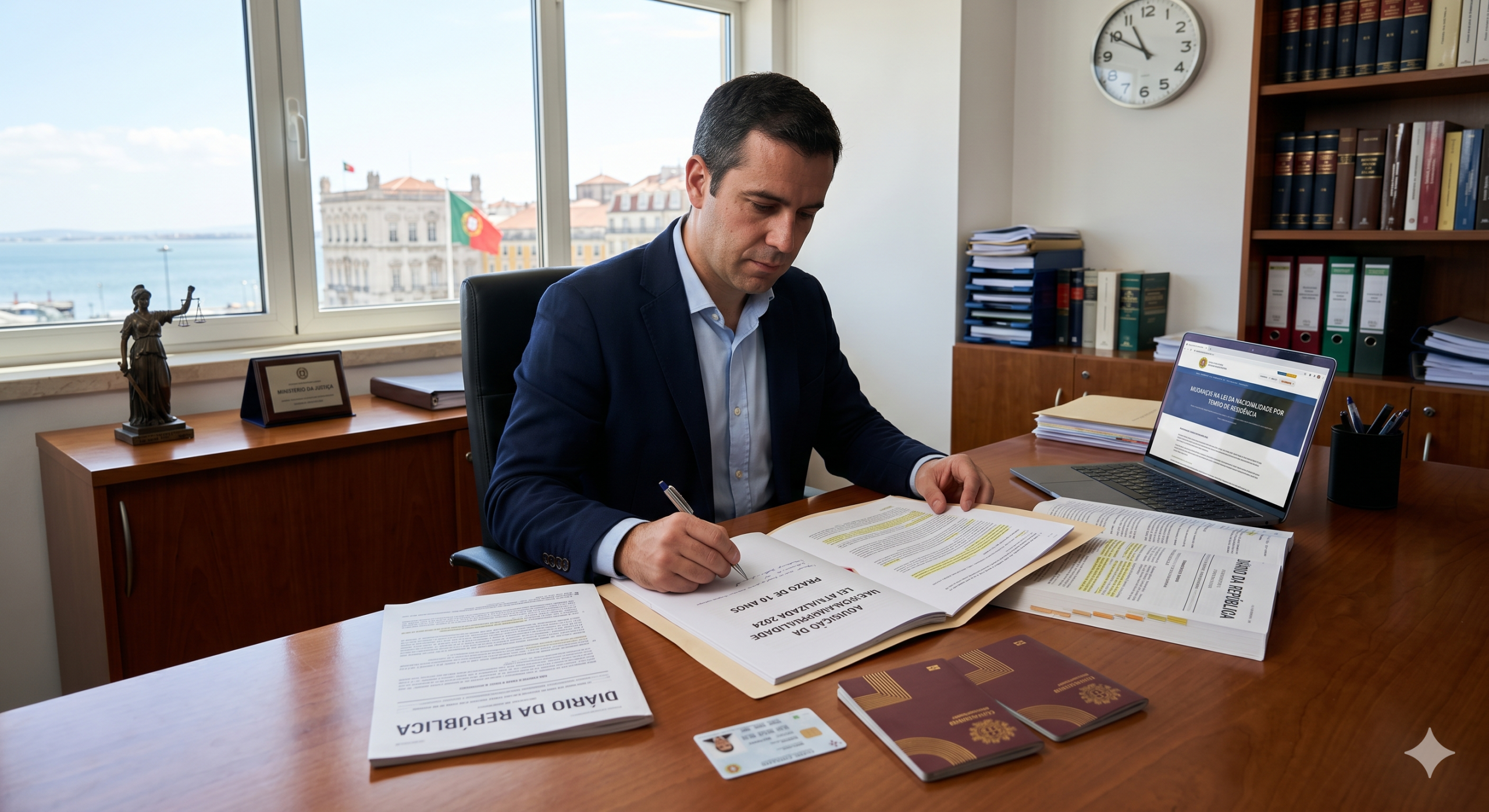
Portugal’s New 10-Year Citizenship Rule: What It Actually Means for Americans
If you’ve spent any time in the “moving to Portugal” corner of the internet over the past few weeks, you’ve probably seen the headlines — and felt your stomach drop. Portugal doubles citizenship timeline. Five years becomes ten. The door is closing.
Take a breath. As someone who lives here, practices real estate here in Portugal, and walks Americans through this process every day for a living, let me help to ease your apprehension: the law did change, it is now in effect, and it matters — but let’s lean into knowledge rather than falling into despair and confusion.
Here’s the honest breakdown.
What actually changed
On May 18, 2026, Portugal published its revised Nationality Law (Lei Orgânica n.º 1/2026) in the Diário da República, the country’s official gazette. It came into force the very next day, May 19, 2026. So this is no longer a proposal or a “pending” debate — it is the law of the land now.
The core change is this: the number of years you must legally reside in Portugal before you can apply for citizenship has gone up.
- For most foreign nationals — including Americans — the wait is now 10 years, up from five.
- For citizens of the EU and Portuguese-speaking (CPLP) countries, it’s 7 years.
- The clock now starts from the date your residence permit is issued, not the date you first submitted your application.
That’s the headline everyone is reacting to. And if your single, non-negotiable goal was the fastest possible EU passport, then yes — this is a real setback, and I won’t pretend otherwise.
But for most of the people I work with, as well as for myself, that’s not actually the goal. And that’s where the panic begins to subside.
What did NOT change (this is the part nobody’s shouting about)
Here is what the new law leaves completely untouched:
Your ability to move to Portugal. The D7 (passive income / retirement) visa, the D8 (digital nomad) visa, the Golden Visa — none of these changed. The income requirements, the application process, the right to live here: all the same.
Permanent residency after five years. This is the big one. After five years of legal residence, you can still apply for permanent residency — exactly as before. Permanent residency gives you the indefinite right to live in Portugal, access to healthcare, and the stability most relocating Americans are actually looking for. The five-year milestone didn’t disappear. It simply stops being the citizenship finish line and becomes the permanent-residency finish line.
Your day-to-day life here. Living in Portugal, working here, traveling visa-free through the Schengen zone, building a life — none of that requires a Portuguese passport. It requires residency, which is unchanged.
So if you read one thing in this post, read this: the new law changed the timeline to a passport, not the timeline to building a life in Portugal.
If you’re already in the process
If your nationality application was already filed on or before May 18, 2026, you’re protected. The law contains a transitional rule keeping pending applications under the previous five-year framework. You do not start over.
If you’ve reached five years of residency but hadn’t yet filed when the law took effect, this is exactly the situation to get qualified legal advice on — quickly. I keep a short list of immigration attorneys I trust and can point you in the right direction.
A couple of practical notes that haven’t changed: you still need to demonstrate A2-level European Portuguese (the CIPLE certificate or an accredited course) and a clean criminal record to naturalize. And the government still has yet to publish updated implementing regulations — expected over the summer of 2026 — which should clarify some of the open questions, particularly around how already-accrued residency time is counted for people not yet at the application stage. I’m watching that closely.
On a personal note regarding the A2-level requirement: I suggest going further than that. Your goal should be learning the language to build a life and become a part of the Portuguese community, not just for the purpose of ticking a checkbox for a passport.
Should this change your decision to move?
Honestly? For most people, no — but it should change how you frame the move.
If you were coming to Portugal to build a life — the climate, the safety, the pace, the healthcare, the sense that your days belong to you again — then a passport ten years out versus five years out changes very little about the next decade of your actual life. You’ll have permanent residency. You’ll be settled. Citizenship becomes a later milestone rather than a near-term finish line.
If you were coming to Portugal purely as a fast track to an EU passport — perhaps to then live elsewhere in Europe — then this is a genuine strategic shift, and Portugal may have lost some of its edge against other countries. That’s a real conversation worth having, and it’s one I’m happy to have honestly, even when the honest answer is “let’s look at your alternatives.”
The mistake I’d hate to see you make is letting a headline about passports scare you away from a decision about your life. Those are two different questions.
Let’s figure out what it means for you specifically
Immigration law is rarely one-size-fits-all, and your timeline, your nationality, your family situation, and your reasons for moving all change what this law means in practice. Generic blog advice — including mine — can only take you so far.
If you’re trying to make sense of where you stand, that’s exactly what my complimentary 30-minute Discovery Call is for. I’ll listen to your situation and tell you honestly how this change affects you, and what your real options look like. No pitch, no pressure — just clarity.
Schedule your free Discovery Call →
And if you’re at the earlier “I’m still gathering information” stage, start with my free guide, Portugal Without the Guesswork — it covers visas, healthcare, cost of living, and what your first year here actually looks like, without the hype.
This article reflects the law as published in May 2026 and is for general information only — it is not legal advice. Immigration and nationality decisions should always be confirmed with a qualified Portuguese immigration attorney based on your individual circumstances.






Incredibly informative!
Thank you!